
Originally posted in January 2014
I must admit that I used to take my hands for granted. I began to realize their importance as I worked with students on a self-portrait project inspired by Wendy Ewald’s The Best Part of Me: Children Talk About Their Bodies in Pictures and in Words. Through the portrait making process, I have grown to understand and appreciate how deeply our hands connect us to each other and to everything around us.
In his book, The Hand: How It Shapes the Brain Language and Human Culture, Frank R. Wilson questions where we would be without our hands, stating “Our lives are so full of commonplace experience in which the hands are so skillfully and silently involved that we rarely consider how dependent upon them we actually are,” and in a National Geographic article entitled The Common Hand, Carl Zimmer eloquently states, “The hand is where the mind meets the world.”
When I asked the group of ten and eleven-year-olds to create photo portraits of their hands as a way to express their identities, I discovered a little bit about how their hands help them meet the world—and they learned a lot about themselves and each other as they explored how they create, play, and make connections through their hands.

We began the project with a simple activity to get us thinking about our hands and how they are helpful. The students traced outlines of their hands in which they brainstormed all the reasons why their hands are important to them. Students listed their hobbies such as sports and drawing along with ways they use their hands to care for pets and help parents with chores.
I then introduced the idea self-expression through self-portrait by sharing several photos I had taken of my own hand. Through each image, I attempted to show a different emotion, such as anger, calm, excitement, and openness. The students and I discussed the photographs as we analyzed what each image was expressing.

After we talked about all the ways our hands can be used to express an idea or emotion, I explained the variety of options they had for photographing their hands. When they got to work, most partnered up because they quickly discovered that it is almost impossible to take a photo of one’s own hand with an iPad. The students were encouraged to explore and be creative as they considered composition, including background, perspective, and lighting.
The expressive portraits they created astonished me. One student placed her hand against a poster of the clouds that included the word imagine, and another choose to take a photo of her hand as she reached toward a flower. Several of the boys decided to focus on sports while one made a peace sign symbol in front of a map of the United States. He said he wanted to express his desire for world peace.

After the students had the opportunity to make several images, we turned our efforts to writing about our hands. After looking everywhere for a poem that could be used as a mentor text, I was inspired to write my own.
My Hands
Janis Selby Jones
My hands are precious and creative.
They are lined but they are strong.
They help me tell my story.
My hands labor in the garden.
They pack the earth tight around a sculptural succulent.
They pick colorful flowers and pull insidious weeds.
My hands work hard in the kitchen.
They season sauces and savory delights.
They make delicious meals for my friends and family to enjoy.
My hands make art.
They draw portraits and paint mountain landscapes.
They create fantastical pictures that only I can imagine.
My hands are precious and creative.
They are lined but they are strong.
They help me tell my story.
As we studied the poem, the students pointed out the repetition and patterns they observed. They were then able to apply what they noticed to their own writing. The students wrote drafts that they typed in a word processing app and added one of their images to their document. Their products were well done.
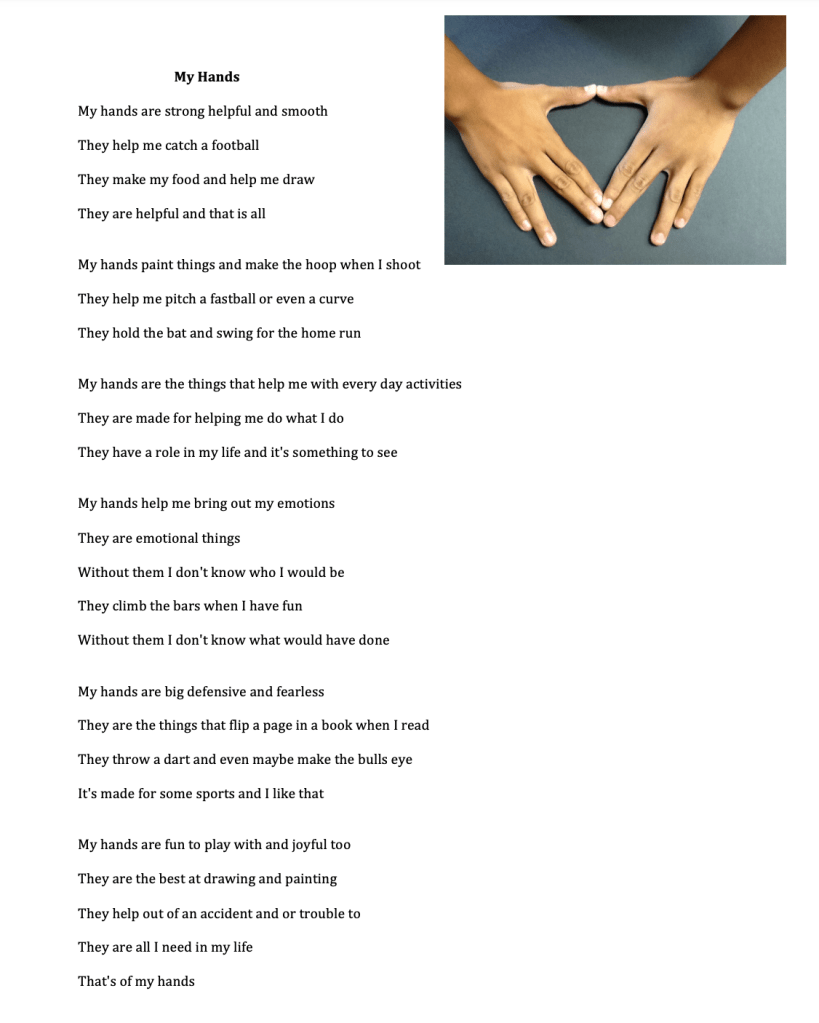
We decided to go one step further by creating multi-media digital projects using a now defunct app called ShadowPuppet, which was similar to the currently available Adobe Spark. Our culminating activity was a film festival of sorts. We watched the videos and responded to each other with positive feedback. Sharing was the most difficult part for many of the students. A few were embarrassed to open themselves up in such personal ways, but in their reflections, the students who expressed concerns about sharing also expressed that they were proud of themselves for overcoming their shyness and allowing others to view their personal works.
The students and I got to know and understand ourselves and each other better by sharing our thoughts and feelings about our hands. In his reflection L.H. stated, “I learned that my hands are very special for many reasons. I also learned that my classmates admire their hands too.”
J.H. shared that he learned “that all of my classmates have a cool part about them because I never knew that D.S. could make home-baked goods or that M.N. liked playing volleyball. I never knew a lot about my classmates.”
You too can get to know a few of these special fifth grade students by watching their amazing multi-media presentations posted below. They might even inspire you to get to know yourself a little better by reflecting on all the reasons why your hands are important to you.


 ShoreSweep